

Lessons from Tehran
Iran's winning strategy did what Venezuela couldn't: make America pay too high a cost for wars of choice.

The moon over Caracas on the night of Friday, January 2nd was one night short of full, and for a few hours that moon was nearly the only light the city had. According to US president Donald Trump, American cyber-warfare units had reached into Venezuela’s power grid and switched off all the lights in the capital.
Under the light of that moon, US helicopters came in low and fast, trading fire with Venezuelan air defenses. The operation required more than 150 aircraft: fighters, bombers, surveillance aircraft, intelligence platforms and helicopters. American strikes disabled those air defenses, hitting military sites around the capital while Delta Force moved through the dark toward the home of Venezuela’s president.
By the time the soldiers reached Nicolás Maduro and his wife, Cilia Flores, the president and the first lady were trying to get behind the steel door of a safe room. They didn’t make it in time. According to General Dan Caine, Chairman of the Joint Chiefs of Staff, the assault on the compound lasted less than thirty minutes. By morning, Maduro and Flores were packed aboard the USS Iwo Jima in the Caribbean Sea, and from there Maduro was flown to New York to face charges brought under American law.
Washington called the operation an arrest. This “arrest” cost the lives of anywhere between 58-100 people (depending on whether one prefers US or Venezuelan sources), including civilians who died when American strikes hit residential areas. At least two civilian women were identified among the dead: Rosa González in Catia La Mar, and Johana Rodríguez Sierra, a mother of three, near El Hatillo.
Arrests don’t normally require bomber aircraft, or for a foreign country’s sovereign integrity to be violated.
Article 2, paragraph (4) of the United Nations Charter prohibits the use of force against another state’s territorial integrity or political independence. International law also recognizes personal immunity for incumbent heads of state before foreign national courts. But, as always, Washington had a ready-made exception for their violation of international agreements they themselves signed. Their “loophole” is that Maduro was never a legitimate president to begin with. The superseding indictment calls him Venezuela’s “de facto” ruler, which places the executive branch’s political judgment about his legitimacy inside the criminal case against Maduro.
The closest American political precedent is Manuel Noriega, whom US forces extracted from Panama in 1990, and tried in Miami. But for most of his tenure, Noriega was not Panama’s formal president. In fact, he was commander of the Panamanian Defense Forces, and never claimed the title of President. The Panamanian National Assembly declared him “Head of Government” on the 15th of December 1989, only five days before the US invasion of Panama. So while Maduro’s case isn’t completely unprecedented, it does point to something that every developing nation and emerging power in the world should take note of: America can simply claim the right to decide that a foreign president is not, in fact, a legitimate president, and therefore not entitled to any immunities or protections attached to the office. They can fly warplanes into your country, kill your soldiers and civilians, kidnap your head of state, and say “This is all being done by the book.”
But putting Maduro in an American prison was only half of what the operation accomplished. The other half was putting Venezuelan policy under American management. Two days after the raid, Delcy Rodríguez invited the United States to collaborate with her government on a new agenda, and announced that Venezuela would pursue what she called “balanced and respectful” relations with the country that had just bombed its capital, killed scores of people, and kidnapped her predecessor from his own home. Four days later, Trump announced that he was cancelling a planned second wave of attacks, because Venezuela had begun releasing what western news and human-rights agencies described as “political prisoners” and was cooperating with Washington. Less than two weeks after Maduro’s capture, Rodríguez was meeting with CIA Director John Ratcliffe in Caracas to discuss intelligence cooperation and “economic stability.” For any country whose primary natural resource is oil, it’s universally understood what American intelligence means by “economic stability.”
Under Rodríguez, the Venezuelan government immediately got to work rewriting the country’s hydrocarbons law, stripping away much of the operational, export, and revenue controls of Venezuela’s state oil firm PDVSA. Washington’s Office of Foreign Assets Control (OFAC) then authorized Western oil companies BP, Chevron, Eni, Repsol, and Shell to operate in Venezuela. Any new oil contracts that Venezuela wants to sign are subject to prior OFAC approval.
Any companies based in or connected to China, Russia and Iran were, of course, excluded. Even Venezuela’s oil royalties, production levies and federal taxes have to pass through a collection of US Treasury accounts, while US Energy Secretary Chris Wright declared that Washington would continue controlling Venezuelan oil-sale proceeds until Venezuela established what he called a “representative government.” Long story short, America achieved the outcome they’d been salivating for in the nearly 30 years since the election of Hugo Chávez: it is once again in control of Venezuela’s oil.
Washington rewarded each step. In March, the United States formally recognized Rodríguez as Venezuela’s leader. In April, it removed the personal sanctions against her. Her government opened Venezuela’s mining sector to private and foreign exploitation, promised legal and security guarantees to prospective investors, and hosted delegations of American officials and corporations in Caracas. Donald Trump repeatedly praised Rodríguez for cooperating with the United States and for rapidly opening Venezuela’s oil and mineral wealth to foreign capital. Washington never needed to install its preferred opposition figure in Miraflores. It had something more useful: the institutions of the existing Venezuelan state carrying out a program Washington could supervise, approve and reward. Maduro’s government survived in personnel. Its policy of resistance did not.
The following month, during Ramadan, America and Israel began a joint bombing campaign against Iran. But it didn’t go the way they expected. Instead, Iran not only withstood the bombing long enough to force an end to major hostilities, it inflicted enough pain on its aggressors that the best outcome available to Washington became a return to the status quo before the bombing campaign began. And according to the signed Islamabad Memorandum of Understanding between the United States and Iran, that is far from what Washington got.
When the US and Israel declared and demonstrated their objectives during the initial wave of bombings against Iran on February 28th, 2026, you could strip them down to three central goals: fracture Iran’s leadership, destroy its nuclear program, and disable the ballistic-missile force that allowed Iran to retaliate across the region. The ancillary goal, whether they wanted to say it explicitly or not, was to attempt to humiliate and demoralize the Iranian people into believing they were unsafe as long as they resisted outside aggression.
The political objective was unmistakable from the moment the campaign began. On day one, the bombings killed Supreme Leader Ali Khamenei. While bombs were still falling around the ears of the Iranian public, Trump held a press conference to tell Iranian people: “When we are finished, take over your government. It will be yours to take.”
This is the ongoing political logic of the US, going back to the Cold War: kill or subvert the leadership of a non-compliant country, destroy its supporting institutions, and install an obedient political body to inherit what remains. The operation in Caracas showed how quickly political decapitation could be converted into a new relationship with the United States. The bombing of Iran was supposed to be the larger version of the same lesson.
The United States and Israel killed the Supreme Leader, bombed military targets, and infamously killed civilians, including 120 children and 37 staff members at Shajareh Tayyebeh Elementary School. But what they did not do was collapse Iran’s willpower. If anything, they only strengthened it. Iran named Ali Khamenei’s son Mojtaba Khamenei as its Supreme Leader, and the state not only continued to command its armed forces, but decentralized it using the Mosaic Strategy, and retaliated with such unexpected force and accuracy on US military bases within Saudi Arabia, Kuwait, Qatar, and the UAE, that military bases were emptied out, airports shut down, and the US military’s THAAD radar was damaged in a drone attack. Israelis were also forced to hide out in bomb shelters. Subjected, for once, to the kind of shock-and-awe campaign they so readily support against their neighbours.
And after all of that, the Iranian opposition did not, in fact, take control of the government. The existing government didn’t capitulate to the demands of its aggressors. Washington and Tel Aviv had slammed into the mountainside of Iranian resilience, their first goal failed.
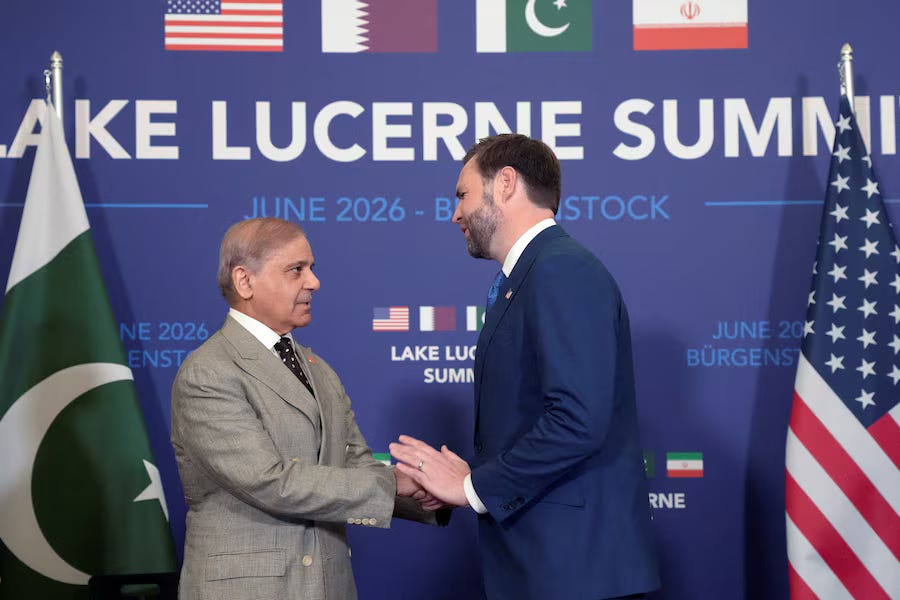
As for the Iranian missile program, the signed MoU contains no provision addressing the dismantling or scaling-down of Iran’s ballistic-missile force. There is language about nuclear weapons, enriched material, sanctions, frozen assets, oil waivers, Hormuz and a future final deal. But the missile force that allowed Iran to retaliate across the region is not surrendered in the text. So far in the Switzerland peace talks, Iranian missile defense does not seem to be under discussion. Even US Vice President J.D. Vance has, amazingly, gone on the record asserting that Iran has a right to defend itself. The second goal has also failed.
Which brings us to nuclear weapons. Under the signed MoU, Iran reaffirms that it will not procure or develop nuclear weapons. The current status of its nuclear program is supposed to be maintained in the interim, the enriched-material stockpile is to be handled through a mutually agreed mechanism, and downblending is to take place with the supervision of the International Atomic Energy Agency. But nuclear enrichment, Iran’s future nuclear needs and the final framework are still left for the next round of negotiations. Which more or less takes the nuclear question back to where it was before the war was launched to begin with.
Regime change failed. Missile disarmament wasn’t even mentioned in the MoU. The nuclear question was deferred under an interim restraint. Iran did not emerge untouched; no country bombed for one hundred and seven days emerges untouched. But the United States accepted a signed memorandum that looks nothing like the political and military transformation it sold to the public when the war began. And it appears to be on course for a “deal” that codifies a humiliating military loss.
But at least the Strait of Hormuz is re-opened, right?
Well, that depends on whether the Switzerland agreement holds, and whether Israel can be brought to heel by a Trump administration that has, so far, given them a blank slate to inflict its Lebensraum campaign on Lebanon. But the discussion around the strait often borders on bizarre, as western media and politicians describe the maritime passage as if it’s a global public commons. Multiple mainstream news outlets, in addition to political officials like the EU’s Luigi Di Maio, US Secretary of State Marco Rubio, and Donald Trump himself, have referred to the Strait of Hormuz as “international waters.” But Hormuz is not, in fact, international waters. It is a strait used for international navigation, and it runs through the territorial waters of Iran on the northeastern side, and Oman on the southwestern side.
After the contents of the MoU were revealed, European Commission President Ursula von der Leyen said “Freedom of navigation must be restored toll-free.” But the signed text of the MoU doesn’t settle the long-term question that way. It does give Washington sixty days of no-charge passage. But after that, the future administration and maritime services of the Strait are still supposed to be discussed with Oman and other nearby states, in line with the sovereign rights of those states whose coasts run along the strait.
In addition to the reopening of the Strait, there’s the question of Iran’s “payment” from the US, starting with a multibillion dollar lump sum. Contrary to what many have asserted, Iran was not paid with American money. This was Iran’s own assets, which have been frozen since the Iranian Revolution. The signed MoU commits the United States to make Iran’s frozen or restricted funds fully available for use, and to issue the licences and authorizations needed for the Central Bank of Iran to direct payments to whomever it sees fit. Reuters has reported the restricted-assets figure at roughly twenty-five billion dollars, which are assets that sanctions had prevented Iran from using. A financial blockade, for the purpose of starving a country into submission, does not become generosity when the blockading power agrees to loosen it.
And then there’s the three hundred billion dollars, which, if one is algorithmically pushed into the wrong corners of social media, is a cheque being written by American taxpayers. The MoU does call for the United States and regional partners to develop a reconstruction and economic-development plan worth at least three hundred billion dollars. But all legitimate reporting on this money describes it as a private investment and financing mechanism. It’s not US taxpayer money, or just some gift handed to Iran out of the goodness of Washington’s heart. Not even the American people get that kind of gift, it’s something you’re only entitled to if your passport says “Israel” on it.
Venezuela and Iran are obviously two very different countries, with a completely different set of circumstances. One emerged as Bolivarian socialism struggling against and gradually overcoming a US-backed banana republican order; the other is an Islamic republic that emerged from a popular uprising against a British- and American-backed monarchy. They have different political economies, social bases and theories of the state. While they didn’t share ideology, they did share strategic disobedience over decades, and a willingness to fight western attempts to recapture their oil economies. Which naturally meant that neither country could accept Washington’s attempts to determine its leadership, alliances, control over natural resources, and political destiny.
But the decisive difference between their means of resistance was the ability to make western intervention so costly that it would have been better to leave them alone. In addition to its geography dooming any attempt at political kidnapping to fail, Iran also has a robust missile and defense industry and military strategy capable of sustaining retaliation, managing regional defense without relying on a central command structure, and, through its cheaply produced but highly effective drone fleet, controlling the sea passage through which roughly one-fifth of the world’s oil and liquefied natural gas had been moving.
Venezuela on the other hand has massive oil reserves, and a large standing military, but it does not have an equivalent way to transfer the cost of a US attack back to American bases, regional partners in South and Central America and the Caribbean, shipping lanes, and ultimately the cost of living inside the US.
Iran’s retaliations, and its closure of the Strait of Hormuz, reflected that cost into the global economy. Oil prices rose rapidly, the shipping of oil, natural gas, fertilizer, and other goods essential to the global economy was disrupted, and American inflation reached 4.2 per cent in May, its highest annual rate since April 2023. Energy prices were 23.5 per cent higher than a year earlier and accounted for more than sixty per cent of the monthly increase in the consumer-price index. And on top of all that, Dubai’s tourism industry cratered while its real estate market took a major hit. The mere idea of peace, far from guaranteed and easily derailed by Israel’s relentless pursuit of ethnic cleansing in southern Lebanon, produced a market rebound nonetheless.
Venezuela couldn’t impose a comparable continuing cost for violating its borders, or its integrity as a sovereign state. Even though the operation obviously required months, if not years of intelligence work, and the cost of deploying aircraft, soldiers, and naval vessels, no part of the operation resulted in a long-term burden capable of forcing Washington to bargain over Maduro’s return. The cost was easily paid.
Which is indicative of a brutal reality: the so-called “international order” does not treat sovereignty as a right among states. Despite how often one hears the truism “Israel has the right to exist” repeated by politicians and mainstream news, it’s fairly obvious that any smaller state who’s not willing to let western countries steal their treasures and run their political affairs, has no such right. Which means there’s a price to state sovereignty, and that’s a price that has to be collected from the US, Israel, and even EU member states like France for violating it. When smaller countries can raise the price of violating their sovereignty high enough, the same powers that call their governments illegitimate suddenly discover words like “ceasefire,” “negotiation,” and “mutual respect.”
Of course this isn’t to celebrate, say, the fragments of intercepted missiles landing on innocent people’s homes. Ordinary people in countries like Jordan and Bahrain often suffer the consequences of a devil’s bargain they never agreed to, once the fragments of missiles and interceptors colliding in midair proceed to fall on their homes. A world in which smaller states require the capacity to devastate others, in order to remain sovereign, is not a sane world or a just one. But when it comes down to it, there’s only one language that imperialist countries seem to understand.
So next time a smaller country is described as dangerous because it’s building missiles, hardening bases, or coming down hard on political opposition that begs for western intervention, the first question should not be whether these countries or their measures are “threatening.” The first question should be what that country expects Washington to do, if they don’t end up paying a very high cost for doing it.