

No, Burkina Faso Didn’t Just Become Pro-Israel
A routine diplomatic ceremony turned into a viral narrative of betrayal. The truth is much less dramatic.

On June 26th, Burkina Faso’s Minister of Communications Pingdwendé Gilbert Ouédraogo appeared on state television to announce the end of diplomatic relations with France, effective immediately. According to Ouédraogo, Paris maintained “neo-colonial ambitions” and were known to support the “subversive networks and the terrorists” bleeding the Sahel through endless waves of attacks on both military and civilian targets.
The buildup to this diplomatic severance was three years in the making. Only months after the military coup that put Burkinabé president Ibrahim Traoré in power, French troops were ordered out in early 2023, and the French ambassador recalled soon after. Then, in 2024, Burkina Faso expelled French diplomats. When Burkina Faso ended the Burkinabé-French military accord in 2023, the government insisted it was “not the end of diplomatic relations” between the two countries. But after two years of worsening relations and endless fighting against terror groups across the Sahel, Burkina Faso finally ended relations definitively in June 2026. For many who lionized Traoré, as well as the allied Sahel movement for self-determination, it came as a mortal blow against the former colonial master that had inflicted well over a century of bloodshed, suffering, and instability across the region.
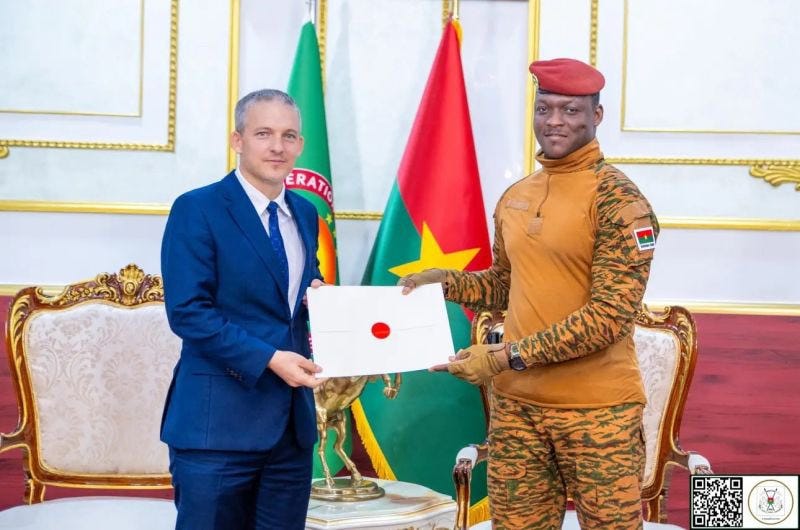
And then, only days later, a photograph circulated across X (formerly Twitter) that nearly overshadowed this story. In the picture, Traoré could be seen shaking hands with Simon-Clément Seroussi, Israel’s ambassador to Côte d’Ivoire (and accredited ambassador to Benin, Togo, and Burkina Faso). The image in itself was proof of betrayal: the defiant country whose young leader had just faced down France, and become a folk hero to Africans dedicated to sovereign power over their own futures, had allegedly turned heel and embraced Israel. According to Seroussi’s own LinkedIn account, the handshake symbolized a continuance of the “longstanding ties” between Israel and Burkina Faso, and spoke of an “enduring friendship” between those countries.
What could possibly explain this?
Well, what happened in Koulouba was a credentials ceremony, the most routine event on the calendar of any newly-assigned ambassador. Burkina Faso did not sign any pacts with Israel, establish any new agreements, or commit to changing their consistent record of UN voting against Israel. It was a photographed handshake, much as another handshake was photographed with another Israeli ambassador in 2023. Unfortunately, for westerners who know next to nothing about the region or its history beyond Thomas Sankara’s martyrdom, developing countries who’ve committed to a revolutionary path exist as little more than action figurines who can be discarded the moment the sheen of novelty wears off, and once they begin doing the unpleasant things that states struggling for sovereignty must inevitably do.
Simon-Clément Seroussi is not posted to Ouagadougou. He resides in Abidjan, the commercial capital of Côte d’Ivoire, and, again, is accredited to four countries at once: Côte d’Ivoire, Togo, Benin and Burkina Faso, according to Israel’s own foreign ministry. This is not a new relationship. Burkina Faso’s diplomatic history with Israel goes back to 1961, not long after Upper Volta (Burkina Faso’s predecessor state) became independent from France. Relations were severed in 1973 under Sangoulé Lamizana, after the October War destroyed relations between not only Israel and the Arab nations of the Middle East, but almost every African nation save for Mauritius, Swaziland (now Eswatini), Lesotho, and Malawi. But in 1993, relations between Burkina Faso and Israel were restored after the Oslo agreement. In fact, 2008-dated Wikileaks documents show that former president Blaise Compaoré attempted to win favour with the US, by courting a closer relationship with Israel during the Zionist entity’s 60th anniversary celebrations.
Burkina Faso’s relationship with Israel is, of course, much different from its partner states Mali and Niger. Mali followed suit with the vast majority of Africa in 1973, and broke diplomatic relations with Israel. It has never restored them, given Mali and the US have historically enjoyed a strong relationship, especially in the post-9/11 period where Mali became a US partner in counterterrorism, and subsequently received aid and military training. Former Malian president Boubacar Keïta did meet briefly with Benjamin Netanyahu in Liberia, during a 2017 regional summit (and Netanyahu spoke of “warming” the relationship between their respective countries), but nothing of substance materialized from there.
Niger’s history with Israel is somewhat uneven: it cut ties in 1973, restored them after the Oslo agreement, then severed them again in 2002 during the Second Intifada. So while the other AES bloc nations have mostly maintained their distance from Israel, Burkina Faso’s current government inherited a diplomatic relationship from previous leadership that, like all too many African nations at the time, had sold out their national interests to the west in exchange for maintaining their grasp on power.
As things stand today, all of Burkina Faso’s non-AES neighbours (and members of broader ECOWAS economic bloc) have diplomatic relations with Israel. Côte d’Ivoire hosts an Israeli embassy in Abidjan, Togo and Benin are covered by Seroussi’s diplomatic assignment and Ghana has its own Israeli embassy in Accra. Relations with Côte d’Ivoire were re-established in 1980 (not long after the Egypt-Israel treaty of 1979), Togo in 1987 (amidst then-president Gnassingbé Eyadéma’s domestic economic crisis), Benin in 1992 (after the collapse of Kérékou’s government, and the country’s decisive break from socialist policy), and Ghana in 1994, after the Oslo agreement. Israel’s embassy reopened in Accra, in 2011.
Seroussi was not dispatched to Ouagadougou for a trade or military agreement, or any realignment of Burkina Faso’s foreign policy at all. Seroussi was one of a batch of 8 new envoys received in the same accreditation round, much as his predecessor Rony Yedidia Clein presented hers in 2023 along with 12 other envoys.
Incidentally, Clein’s handshake with Traoré also set off speculation about Burkina Faso’s secret pact with Israel, much later in 2025.
Seroussi’s diplomatic cohort represented Saudi Arabia, Angola, Somalia, the Sovereign Order of Malta, Indonesia, Tanzania and Bangladesh. Before any of these ambassadors shook Traoré’s hand, they first handed working copies of their diplomatic letters to Burkina Faso’s foreign minister Karamoko Jean Marie Traoré on the 25th of June. The originals were then presented to the head of state, who posed for routine ceremonial photographs – one of which would later become raw material for outrage-farming online.
Missing in all of this, is the fact that working copies were delivered the day before Burkina Faso cut diplomatic relations with France. In other words, the accreditation of Israeli ambassador Seroussi was already moving through the ordinary diplomatic machinery before the France announcement was made. Based on the online narrative pushed by a small US-based account calling itself the “Institute for Black Solidarity with Israel,” many seemed to believe that Burkina Faso had kicked out Paris, only to welcome in Tel Aviv immediately afterwards.
Receiving an ambassador’s letters of credence simply means recognizing that person as another state’s official representative. It does not mean friendship, ideological alignment, economic cooperation, military procurement, or combat training. It does not mean support for Israel’s genocide in Gaza. States routinely receive ambassadors from countries they sanction, condemn, vote against, negotiate with, spy on, and in some cases engage in mutual combat with. Traoré’s photo with Seroussi was not followed by any announcement of a public security pact, trade agreement, or even a shift in Burkina Faso’s United Nations voting record. The complete extent of the scandal was a non-resident Israeli envoy presenting his paperwork to the head of state, in the same week as seven other diplomats, followed by diplomatic boilerplate on LinkedIn about “longstanding ties” and “enduring friendship.”
Seroussi’s words, mind you, not a Burkinabé statement of policy.
None of this means that all of Burkina Faso’s policies are clean, consistent, or above criticism. Many commentators and publications have already drawn attention to its crackdowns on journalists, Traoré’s public skepticism towards liberal democracy (whether justified or not), and anti-LGBT policies encoded into criminal law. But to many foreigners commenting on these matters, the AES states are not so much “states” as they are symbolic representations of their own fantasies of a perfect revolution. They should be unblemished proof that Africa has finally cast off its fetters, and are ready to pull down the US, Europe, and Israel from their imperialist thrones.
The reality is, the AES bloc are landlocked, poor, heavily sanctioned, diplomatically isolated, and bogged down in fighting longtime insurgencies highly suspected of being backed by France. They need functioning infrastructure, economic redevelopment, and a broader range of trade partners, in addition to weapons, intelligence, and breathing room. They are bordered by militarized, pro-western countries which would gladly accept any pretext to intervene with western backing, and crush their sovereignist project. A diplomatic photo opportunity does not make Burkina Faso pro-Israel; it is an acknowledgment that Burkina Faso is a state: weak in some ways, defiant in others, and forced to operate inside a world where every route to survival comes with the need for compromises.
Even when they come in the form of “bad optics” which appear, at best, unflattering to the type of people who care little about the Burkinabé struggle, and know even less.